
So Israel set out with all that was his, and when he reached Beersheba, he offered sacrifices to the God of his father Isaac. And God spoke to Israel in a vision at night and said, “Jacob! Jacob!” “Here I am,” he replied. “I am God, the God of your father,” he said. “Do not be afraid to go down to Egypt, for I will make you into a great nation there. I will go down to Egypt with you, and I will surely bring you back again. And Joseph’s own hand will close your eyes. – Genesis 46:1-4
My Bible reading plan has me in Genesis 46 this morning, and there’s a lot going on here!
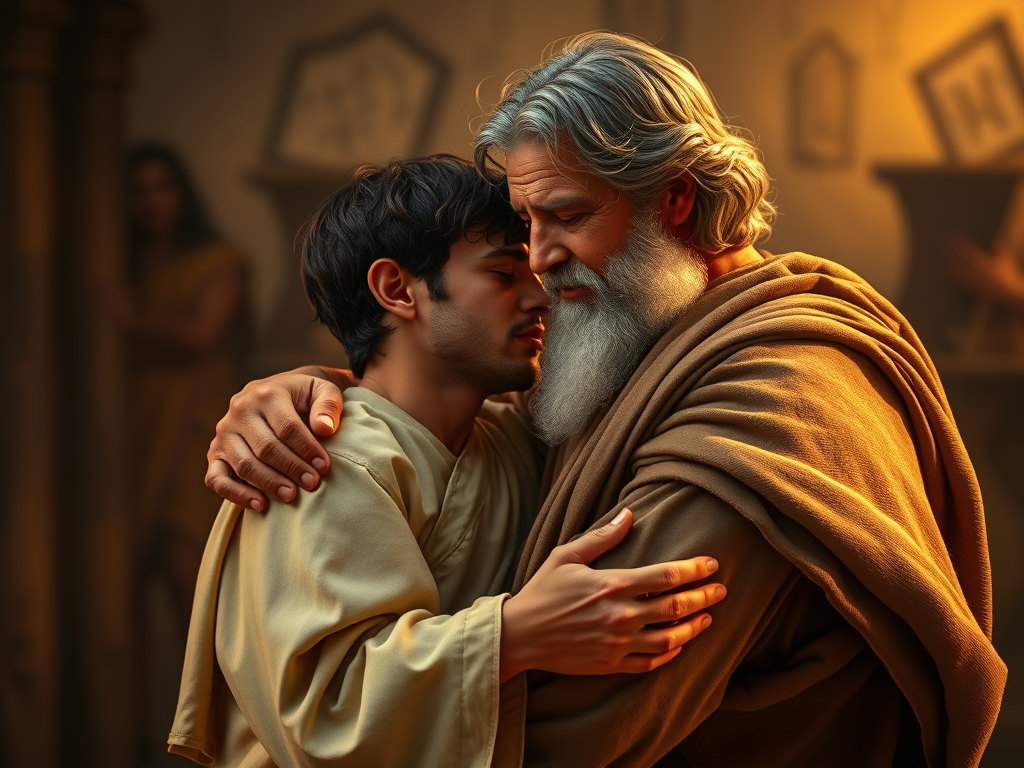
For starters, at long last, Jacob is reunited with the son he thought had been dead for more than 20 years. For whatever reason, I can’t help but picture Jesus’ parable of the prodigal son – albeit reversed. This time it’s the prodigal son (Joseph) running with joy to embrace his father. It’s a deeply human moment layered with relief, gratitude, and joy. God has been at work behind the scenes far longer than Jacob ever realized.
At the same time, God is continuing to move forward the covenant promise He made to Jacob’s grandfather, Abraham. About 215 years earlier, God told Abraham in a dream that his descendants would be strangers in a land not their own, enslaved and mistreated for 400 years (Genesis 15:13). Now, you could argue that Joseph’s unjust enslavement in Egypt was the first hint of that promise taking shape. But Jacob’s arrival in Egypt with his entire family – 70 people in all – feels like the moment when all the loose ends finally come together. What God promised long ago is now unmistakably in motion.
And there’s this tender moment between God and Jacob. God speaks to him directly and reassures him: “it’s safe to go to Egypt.” Not only that – God promises, “I will go to Egypt with you, and I will surely bring you back again.” That’s important! Jacob isn’t just being told where to go; he’s being told he won’t be going alone. God isn’t merely directing the journey – He’s joining it!
What I find interesting, though, is what God doesn’t say. He doesn’t warn Jacob that Egypt – the place of refuge, provision, and survival – will someday become a place of hatred, persecution, and slavery for his descendants. Right now, Egypt looks like salvation. It looks like safety and God’s kindness. (And it is, for now…)
But there’s a quiet omen whispering at the very end of the chapter, one that’s easy to overlook. Joseph instructs his family to tell Pharaoh that they are shepherds, because shepherds are “detestable” to the Egyptians (46:34). That small detail matters! It hints at separation and division… a subtle line being drawn between the Israelites and the Egyptians.
Yes, Egypt will be a refuge – for a while. But after Joseph dies, and after a few generations pass (roughly 80-100 years according to many Old Testament scholars) the hospitality fades. Fear replaces gratitude. And the nation that once welcomed Israel begins to enslave them, just as God had told Abraham centuries earlier.
So what do we do with this today?
I think Genesis 46 reminds us that God’s promises often unfold in layers. What feels like rescue in one season may quietly carry the seeds of hardship in another. And yet – none of that is outside of God’s care or control. God didn’t mislead Jacob. He didn’t abandon Israel. He simply walked them through a story much larger than any one generation could fully understand.
Sometimes God leads us into places that feel safe, necessary, even life-saving, without explaining every chapter that’s still to come. But the promise that matters most is the one God repeats to Jacob: “I will go with you.”
And that’s still the promise we cling to today. Not that the road will always be easy, not that every refuge will remain permanent. But that wherever God leads us, He goes with us – and in His time, He brings us home.
 Former Blackout Artist