
So I was reading Jeremiah 29 the other night, and something jumped out at me almost immediately. Despite Israel being under God’s judgment – despite Jerusalem falling, the temple being destroyed, and people forcibly carried off into Babylon – God tells the exiles to… enjoy life. Go ahead and build houses. Plant your gardens. Get married and have kids. And pray for the city that conquered you. Seek its peace and prosperity. If Babylon prospers – you prosper.
In some ways I find that a bit shocking. Because if I’m one of the exiles, I’m probably expecting a very different message. Something like, “Hold tight. Don’t get comfortable. Judgment is almost over. Babylon will fall any day now.” Instead, Jeremiah’s letter says, “Settle in. You’re going to be here a while.”
That raises a lot of questions. And honestly, I think it raised them for the exiles too. How could it not?!
“Wait… you want us to pray for them?”
“Seek the peace and prosperity of the city to which I have carried you into exile. Pray to the Lord for it…” (Jeremiah. 29:7).
Babylon isn’t just neutral territory. It’s the enemy. Nebuchadnezzar is the one who leveled their city, humiliated their leaders, and dragged them away from home. And yet God says, Pray for Babylon.
That had to sound confusing.
But here’s the thing: God isn’t endorsing Babylon’s violence or idolatry. He’s asserting His sovereignty. Babylon may think it won, but God reminds Israel, “I carried you into exile.” Even Israel’s enemy empires are tools in His hands. But more than that, God is teaching His people how to live faithfully in exile, not just how to survive it. If the city prospers, they will too. So stability and peace matters. Instead of pulling away in anger or fighting everything around them, God calls His people to live faithfully in the place they find themselves.
In a sense, God’s grace spills outward. Babylon benefits because God’s people are there. That’s always been the pattern. Abraham was blessed so that others would be blessed. Even in judgment, God’s purposes are bigger than punishment.
“Why build families if we’re under judgment?”
Then there’s the command to marry, have children, and multiply. This one fascinates me!
God doesn’t say, “pause life until things get better.” He says, “keep living.” That suggests something important to us – the exile is not the end of the story! God is preserving a people, not dismantling them.
This is where I think some of us misunderstand the exile, namely myself for years. I used to see the exiles as the ones absorbing the full weight of God’s wrath. But in reality, they are the remnant – the ones God is intentionally preserving so His covenant promises don’t disappear from history. But then, I’m reminded of a sensitive issue that comes later on in Ezra and Nehemiah – about intermarriage – something that was expressly forbidden in the Law, but something seemingly unavoidable given the Lord’s command. It would eventually lead to enormous grief and confusion, and the reforms would prove extremely painful. And yet, we must keep in mind that this wasn’t about cultural compromise. It was about surviving and maintaining continuity. God’s priority here was that His people didn’t vanish through despair, isolation, or hopeless waiting.
God often works through imperfect circumstances. Preservation sometimes comes with dramatic tension. But extinction would have ended the promise altogether. And that wasn’t going to happen.
“This doesn’t sound like God at all, Jeremiah. In fact, other prophets are saying something completely different!”
There were no fiery countdowns, nothing overly dramatic or prophetic. No promises of immediate deliverance. Just houses, gardens, babies, and prayer. This was not the message they were accustomed to hearing from God’s prophet.
And it didn’t help that Jeremiah had competition.
Because in Babylon, there were other prophets – rogue false prophets – who were telling the people exactly what they wanted to hear. They were saying things like “This exile won’t last” and “God will overthrow Babylon soon” and “Don’t settle in and get comfortable.”
Jeremiah calls them liars. Not mistaken, but deceptive. They were resisting God’s plan by offering a more appealing one. And that made Jeremiah’s job infinitely harder. Imagine telling grieving, displaced people who miss home terribly that the comforting voices they’re listening to are actually working against what God is doing. That’s some heavy work.
That reminds us that false hope can be just as destructive as despair. Sometimes even more so.
So what was God really accomplishing?
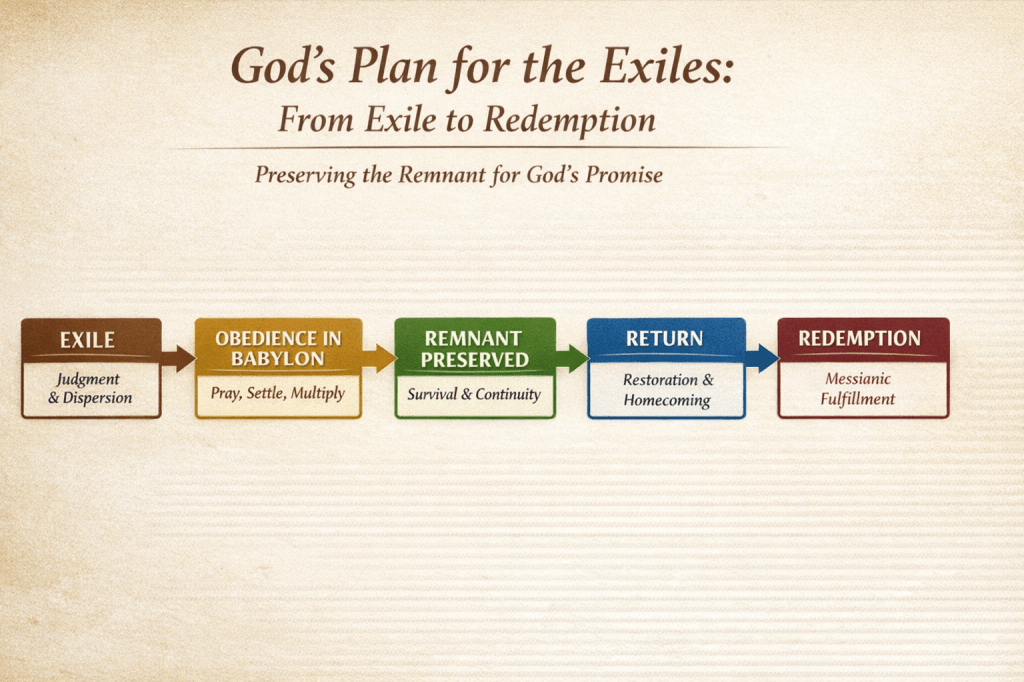
It’s easier to see the bigger picture if we look at it from a distance. God was actually doing several things at once:
- Judging sin – yes, but not annihilating His people.
- Preserving His people – but not abandoning them.
- Teaching His people – how to live faithfully without power, land, or a temple.
- Demonstrating – that His purposes are not limited to geography or politics.
In a way, the exile became a classroom. God was shaping and molding a people who could trust Him when the familiar structures aren’t there.
What does this mean for us some 2600 years later?
Sometimes it may feel like we’re living in Babylon, but we aren’t. But that doesn’t mean that some of us don’t know what it feels like to live in a season that we didn’t choose… whether it’s loss, disappointment, long-term uncertainty, personal health problems, or taking care of a sick family member, etc.
And our instinct is probably much like the exiles’: How fast can I get out of this?
This is where Jeremiah 29 gently pushes back and asks us a harder question: What if God is doing something here?
What if faithfulness right now looks less like escape and more like planting? What if prayer for the “city” we’re frustrated with is actually obedience – like praying for our enemies? What if the loudest, most confident voices we hear today promising quick fixes really aren’t speaking for God at all?
Sometimes God’s plan sounds confusing because it’s quieter, slower, and more ordinary than we expect. But it’s often in those long, unglamorous seasons that He preserves us, reshapes us, and prepares the way for what comes next.
The exiles were not forgotten. They were being kept by God’s Sovereign hand.
And so are you.
 Former Blackout Artist